Haiku 5.5 is out: it costs the same as GPT-6 Luna, until the request passes 100 thousand tokens
Anthropic cut the Haiku price by 90% and tied OpenAI on short requests. Above 100 thousand tokens the price sheet jumps fivefold. In the chat on our own site, the same conversation got seven times cheaper, with two stumbles the announcement does not mention.


Anthropic released Claude Haiku 5.5 on 7 October 2026. On requests of up to 100 thousand tokens it costs US$ 0.10 per million input tokens and US$ 0.50 per million output, 90% less than Haiku 4.5 and exactly the price of OpenAI's GPT-6 Luna. Above 100 thousand tokens the price rises to US$ 0.50 and US$ 2.50, five times higher, and Luna becomes much cheaper. In Anthropic's figures, Haiku 5.5 leaves 4.5 far behind (72.4% against 15.7% on computer use), beats Luna on the six tests they share and trails Sonnet 5.5 on all of them. In ROO3's customer chat, the same conversation cost about seven times less and answered faster, but the model refused an internal task that 4.5 handled without complaint.
What you get from this article
- The identifier claude-haiku-5-5 has been in Anthropic's official catalog since 7 October 2026, with no date suffix and no alias.
- Up to 100 thousand tokens per request: US$ 0.10 input, US$ 0.50 output and US$ 0.01 for cache reads. The same price as GPT-6 Luna.
- Above 100 thousand tokens the price goes up fivefold. In Anthropic's current generation, it is the only model priced by request size.
- Against Haiku 4.5, the jump shows on every test: from 0.0% to 39.2% on Terminal-Bench 4.0 and from 15.7% to 72.4% on OSWorld 2.1.
- It is the first Haiku with effort levels. On two of four tests, Sonnet 5.5 at high scores higher than Haiku 5.5 at max and costs less per task.
- In the test on ROO3's chat, the cost per reply fell from US$ 0.0032 to US$ 0.00045, and the new model refused the internal summary that 4.5 used to write.
- The only independent measurement so far is LiveBench: 72.1, practically tied with GPT-6 Luna (72.0).
What shipped, and where you can already use it
Claude Haiku 5.5 shipped on 7 October 2026 and completes Anthropic's 5.5 family, after Opus 5.5 on 22 September and Sonnet 5.5 on 28 September. It is the company's small model, built for work that runs at volume: classifying messages, summarizing, pulling data out of documents, answering customers and acting as a helper for a bigger model. Anthropic says it is the fastest model it has released at standard speed.
The identifier claude-haiku-5-5 is in the official documentation, with published pricing, and the model already runs on Anthropic's API, Amazon Bedrock, Google Cloud, Microsoft Foundry and Claude Platform on AWS. The name has no date suffix and no alias, and the company commits to keeping the model available until at least 7 October 2027.
The spec sheet moved up a level. The context window went from 200 thousand to 1 million tokens, maximum output from 64 thousand to 128 thousand, and reliable knowledge runs through June 2026. It is also the first Haiku with the effort control, the five levels Sonnet and Opus already had. The default is medium.
The announcement brought two more changes that affect anyone paying for the API. Sonnet 5.5 cache reads were cut in half, from US$ 0.20 to US$ 0.10 per million tokens, which by Anthropic's math makes Sonnet about 20% cheaper on most agentic work. And Max and Team subscribers start getting a monthly API credit this week: US$ 100 on Max 5x, US$ 200 on Max 20x and up to US$ 500 on Team, pooled across users.
Anthropic's table, with seven tests
The comparison Anthropic chose puts Haiku 5.5 next to Haiku 4.5, GPT-6 Luna, the low-cost model OpenAI launched on 22 September, and Sonnet 5.5, included as a reference. Every Haiku 5.5 figure is at max effort, averaged over five runs.
Against its predecessor, the jump shows on everything that was measured. On Terminal-Bench 4.0, which measures long command-line work, Haiku 4.5 scored 0.0% and the new model 39.2%. On OSWorld 2.1, where the model operates a computer to complete multi-step tasks, it went from 15.7% to 72.4%. On chart reading, from 6.4% to 46.4%.
Against Luna, Haiku 5.5 wins the six tests both appear on, with the widest gap on computer use: 72.4% against 48.9%. That Luna number was run by Anthropic itself, through OpenAI's API, on the same 82 tasks. OpenAI did not publish it.
| Haiku 5.5 new | Haiku 4.5 | GPT-6 Luna OpenAI | Sonnet 5.5 reference | |
|---|---|---|---|---|
| Knowledge work GDPval-AA v2.1, Elo score | 1,620 | 735 | 1,437 | 1,840 |
| Long office projects AA-Briefcase v1.1, Elo score | 1,578 | 614 | 1,336 | 1,824 |
| Computer use OSWorld 2.1, offline subset | 72.4% | 15.7% | 48.9% | 83.9% |
| Hard knowledge Humanity's Last Exam, no tools | 45.9% | 10.2% | not published | 56.9% |
| Hard knowledge Humanity's Last Exam, with tools | 57.4% | 18.7% | not published | 64.5% |
| Long terminal work Terminal-Bench 4.0 | 39.2% | 0.0% | 16.4% | 70.6% |
| Software engineering FrontierCode 1.1, Main set | 46.4% | not published | 42.4% | 52.1% |
| Chart reading Chartography, no tools | 46.4% | 6.4% | 29.1% | 61.6% |
Sonnet 5.5 leads every row, and it is in the table precisely to show the gap. The smallest one is on FrontierCode programming, 46.4% against 52.1%. The system card adds a detail the announcement leaves out: with both at max effort, Haiku scores 46.4% and Sonnet 46.2%. Sonnet only pulls ahead when it runs at xhigh.
The customer quotes Anthropic picked are about speed and volume. HubSpot says Haiku 5.5 scored 92.8% on its CRM test suite, the best result it has seen there. AlphaSense, which runs about 8 million calls a week on a document question-answering feature, measured 0.84 against 0.76 for Haiku 4.5 over 400 queries. Box reported 11 points more at roughly half the latency. These are companies invited to test before launch.
The price: the same as GPT-6 Luna up to 100K tokens
On requests of up to 100 thousand tokens, Haiku 5.5 costs US$ 0.10 per million input tokens, US$ 0.50 output and US$ 0.01 for cache reads. Haiku 4.5 charges US$ 1, US$ 5 and US$ 0.10. That is a 90% cut on every line. In batch, half: US$ 0.05 and US$ 0.25.
OpenAI's pricing page lists the same three numbers for GPT-6 Luna, to the cent. It is the second time in two weeks the two companies have landed on the same price sheet, since Sonnet 5.5 already cost the same as GPT-6 Sol. In the low-cost tier, the tie depends on request size.
Above 100 thousand tokens, Haiku 5.5 charges US$ 0.50 input and US$ 2.50 output, five times more. Luna holds its price up to 272 thousand input tokens and, beyond that, charges US$ 0.20 and US$ 0.75. Between 100 and 272 thousand tokens, Haiku costs five times more per token than its rival. It is also the only model in Anthropic's current generation with tiered pricing: Sonnet and Opus charge the same sheet all the way to 1 million tokens.
| Haiku 5.5 new | Haiku 4.5 | GPT-6 Luna OpenAI | Sonnet 5.5 | |
|---|---|---|---|---|
| Request up to 100K tokens input / output | US$ 0.10 / US$ 0.50 | US$ 1 / US$ 5 | US$ 0.10 / US$ 0.50 | US$ 2 / US$ 10 |
| 100K to 272K tokens input / output | US$ 0.50 / US$ 2.50 | US$ 1 / US$ 5, up to 200K | US$ 0.10 / US$ 0.50 | US$ 2 / US$ 10 |
| Above 272K tokens input / output | US$ 0.50 / US$ 2.50 | does not fit | US$ 0.20 / US$ 0.75 | US$ 2 / US$ 10 |
| Cache read request up to 100K tokens | US$ 0.01 | US$ 0.10 | US$ 0.01 | US$ 0.10 |
| Batch processing up to 100K tokens, input / output | US$ 0.05 / US$ 0.25 | US$ 0.50 / US$ 2.50 | US$ 0.05 / US$ 0.25 | US$ 1 / US$ 5 |
Anthropic backs the tier with a figure from its own traffic: 90% of requests sent to Haiku 4.5 were 100 thousand tokens or less. For that majority, the bill drops sharply. Anyone who sends a full contract, a product manual or a long chat history in every request gets a 50% discount over 4.5, and a cheaper Luna.
There is also the ruler. Haiku 5.5 uses the tokenizer Anthropic introduced with Opus 4.7, which counts the same text as roughly 30% more tokens. Adding both effects, the company estimates Haiku 5.5 costs on average about 75% less than 4.5 for the same work, not 90%. If tokens are new to you, the article on what a token and a context window are walks through the math.
The 90% discount applies to nine out of ten requests Haiku 4.5 used to get. For the tenth, the OpenAI rival is now cheaper.
The effort control, and where Haiku at max stops paying off
On Haiku 4.5, the only setting was turning thinking on and giving it a token budget. Version 5.5 gets the five effort levels: low, medium, high, xhigh and max. More effort means more reasoning before the answer, more tokens and more time. Alongside the announcement, Anthropic published the score and cost per task of each level on four tests, with Sonnet 5.5 on the same chart and, on two of them, GPT-6 Luna.
Reading the charts point by point, the same effect we saw with Sonnet 5.5 nine days ago shows up one step down. On two of the four tests, Sonnet 5.5 at high effort scores higher than Haiku 5.5 at max and costs less per task.
| Haiku 5.5 medium, the default | Haiku 5.5 max | Sonnet 5.5 high | GPT-6 Luna max | |
|---|---|---|---|---|
| Computer use OSWorld 2.1, offline subset | 53.3% · US$ 0.13 | 72.4% · US$ 0.61 | 73.2% · US$ 1.38 | 48.9% · US$ 0.20 |
| Knowledge work GDPval-AA v2.1, Elo score | 1,277 · US$ 0.03 | 1,620 · US$ 0.87 | 1,551 · US$ 0.62 | 1,437 · US$ 0.09 |
| Hard knowledge Humanity's Last Exam, no tools | 35.5% · US$ 0.007 | 45.9% · US$ 0.21 | 47.9% · US$ 0.08 | not published |
| Long terminal work Terminal-Bench 4.0, cost per attempt | 20.3% · US$ 0.68 | 39.2% · US$ 2.64 | 43.0% · US$ 1.46 | not published |
Terminal-Bench is the clearest case. Haiku at max scores 39.2% while spending US$ 2.64 per attempt, and Sonnet at high scores 43.0% for US$ 1.46. The announcement itself says that for complex agentic coding, Sonnet and Opus remain the right choice. On Humanity's Last Exam, Sonnet at high beats Haiku's best result spending US$ 0.08 against US$ 0.21.
On the other two tests Haiku holds its ground. On computer use, Haiku at max lands 0.8 point behind Sonnet at high for less than half the cost. On GDPval-AA, which grades professional work across 44 occupations, Haiku at max beats Sonnet at high but spends 40% more per task.
Against Luna, it depends on the level. On computer use, Haiku at medium, the default, already scores 53.3% for US$ 0.13, a higher score for less money than Luna at max. On GDPval-AA the two move together: Haiku at high scores 1,420 for US$ 0.09, and Luna at max scores 1,437 for the same US$ 0.09. At the low levels Luna spends less and scores less: at low, 1,036 points for US$ 0.004, against 1,125 for US$ 0.01 on Haiku.
The rule that comes out of these points is easy to apply. Haiku 5.5 performs best from low to high. If a task only works at xhigh or max, run the same task on Sonnet 5.5 at medium or high before you decide, because it may come out better and cheaper.
On Terminal-Bench, Anthropic's cheapest model running at max spends almost twice what Sonnet spends at high, and delivers less.
We tested it in our own site chat on launch day
The ROO3 site has a customer chat that talks to visitors, works out their problem and hands the contact to WhatsApp with a summary ready for Rodrigo. It was built on Haiku 4.5. On launch day we ran the same conversations on Haiku 5.5, with real API calls, to measure cost, time and behavior before touching production.
Cost dropped the way the price sheet promises. On the same chat reply, Haiku 4.5 spent US$ 0.0032 and 5.5 spent US$ 0.00045, about seven times less. In the assessment script, which uses a tool to record answers, a reply went from US$ 0.0080 to US$ 0.00095, and response time fell from 5.3 to 1.9 seconds. The new tokenizer showed up in the measurement too: the same conversation history came to 3,856 tokens on 5.5 and 2,950 on 4.5, 31% more, close to the 30% the documentation warns about.
The first stumble came with the summary. At the end of the conversation, the system asks the model for a summary for the team, and that request went in as a message inside the customer conversation itself. Haiku 4.5 always complied. Version 5.5 wrote a reply to the visitor saying it would not put that summary together and offering WhatsApp. Without the fix, that text would have landed in the CRM instead of the summary.
Anthropic's system card records the same trait: in its automated behavioral audit, Haiku 5.5 refused legitimate requests more often than any other model the company tested, although on simple single-message requests it refused less than 4.5. The fix in our code was to give the summary its own internal prompt, with the conversation sent as a transcript. After that, both models wrote the summary correctly on all three attempts, and the 4.5 summary got cheaper as well, because it no longer carries the whole customer-service prompt.
The second stumble was in the assessment script, which follows a fixed question order. Over three full conversations, Haiku 4.5 kept the order on all nine replies. Version 5.5 at low effort broke the order on four of nine, and the server had to replace its reply with the standard question. At medium it was three of nine, with slower answers. The assessment result stays correct, because the server does the scoring, but the conversation starts to feel like a form.
The decision: the conversation and the summary move to Haiku 5.5, and the assessment stays on 4.5 until the script is tuned for the new model. It is a small sample, from a single case, and it does not replace a test with your own conversations. It does show the kind of problem no launch table catches.
What broke in the switch was a back-office task, the summary that goes into the CRM. Nobody looks at it until a wrong summary shows up.
What has been measured outside Anthropic
Apart from our test, which is a single case, everything so far was published by the vendor. Haiku 5.5 already has a page on our AI Benchmark, which only gathers independent measurement, and as of this writing the only data is LiveBench: an average of 72.1, 42nd among 57 scored models. GPT-6 Luna has 72.0, and Sonnet 5.5 has 77.8.
Still missing are the Epoch AI composite index (ECI) and the Arena human-preference score, which usually come out a few days after launch. When they do, the model enters the ranking on its own, with nobody typing a number. For now, on the only broad independent test, Haiku 5.5 and Luna are tied.
A comparison between the two Haikus outside the announcement does not exist yet, because 4.5 has no LiveBench average. On the Epoch AI index, Haiku 4.5 has 142.41, 109th among 264 models, and Luna has 156.28, 24th. That is the bar Haiku 5.5 will face when its number comes out.
What breaks in code that uses Haiku 4.5
Changing the model name in your configuration is not enough. Anthropic's migration guide lists the changes, and a good share of them return a 400 error on code that worked yesterday.
- Temperature:
temperature,top_pandtop_kset to non-default values return an error. If you used a low temperature to stabilize answers, the parameter has to go. - Prefilled answer: ending the conversation with an assistant message for the model to continue returns an error, even with thinking turned off.
- Thinking budget:
budget_tokensreturns an error. The control is now the effort level. - Computer use: the old
computer_20250124tool is not accepted on Anthropic's API or on Google Cloud. You need to move to the new toolset. - Refusals: the model has safety classifiers that can decline a request, with
stop_reasonset torefusal. Haiku 4.5 had nothing like it, and there is no automatic fallback model.
Two changes throw no error at all, which is why they catch more people. Thinking is on by default and counts against max_tokens, so a low limit tuned for 4.5 can run out mid-reasoning, with no text at all. And a response can start with reasoning blocks: code that reads the first block as the answer ends up reading the wrong place. In our chat, the limit went up 30%, thinking was turned off for the conversation and a reply with no text now counts as a failure.
If you use a forced tool to get answers in a fixed format, such as a customer's name, phone and intent, the news is good. On Sonnet 5.5 that became a 400 error. On Haiku 5.5 it is still accepted, just with no reasoning before the call. And you can turn thinking off with disabled up to high effort, an option Sonnet 5.5 also lost.
Safety, and what the system card admits
The system card runs 144 pages and is shorter than earlier ones by Anthropic's choice: the company says it will condense the reports for models below the frontier. On the risk evaluations, Haiku 5.5 is broadly below Opus 5 and crosses no new threshold of the company's responsible scaling policy.
The cybersecurity safeguards are stricter than those on Haiku 4.5 and lighter than those on the other recent models. According to the announcement, they allow more defensive work than Sonnet 5.5's safeguards, but they still block penetration testing and techniques more often used by attackers.
Among the less flattering findings, two matter for anyone running the model in production. Over-refusal, which already showed up in our test. And shortcut-taking: on coding tasks where the solution was reachable in the environment, it used the ready-made answer without telling the user more often than Haiku 4.5.
On the good side, no earlier Haiku resisted malicious instructions hidden in pages and files as well, and on coding and computer use it comes close to the bigger models, and it was at least as honest under pressure as every other model tested. Across 42 languages, it averaged 87.8% on Global MMLU, against 92.1% for Sonnet 5.5. Once again, the vendor did the measuring.
What to do this week
If you use AI through the Claude app, nothing changes in your day. If you pay for Max or Team, the new monthly credit is exactly what you need to test a switch like this without touching your budget.
If you run anything through the API, this is the sequence:
- Before switching, search your code for
temperature, prefilled answers,budget_tokensand reading the first block of the response. The first three become a 400 error; the last one silently reads the wrong place. - Measure your request sizes. If a good share is above 100 thousand tokens, the discount over 4.5 drops to 50%, and GPT-6 Luna becomes cheaper per token.
- Redo your cost estimate with tokens counted on 5.5. The same text is worth about 30% more tokens.
- Start at low effort for chat and short tasks, as the documentation recommends, and only go up if quality calls for it. Before using xhigh or max, run the same task on Sonnet 5.5 at medium or high.
- Handle refusals in code and test the back-office tasks, such as summarization, classification and extraction, with the prompt they really use. That is where our test broke.
None of these decisions come from a launch table. They come from running your real tasks on the candidate models and comparing accuracy, cost and behavior side by side, the way we did with our chat. If you have customer service, triage or data extraction running on AI and want to know how much the switch saves in your case without breaking anything in production, ROO3 consulting runs that test with your own conversations and delivers the recommendation with numbers.
What we cannot say yet
First, where Haiku 5.5 sits among models. Without the Epoch AI ECI and the Arena score, the independent data available is a LiveBench result tied with Luna.
Second, what changes in the Claude app. As of this writing, Anthropic has not said which plans and features will use Haiku 5.5 in place of 4.5. Through the API and the clouds, it has been available to everyone since day one.
Third, how OpenAI responds. Luna shipped two weeks earlier and has been matched on short-request pricing, but it stays cheaper on long requests. With the 5.5 family complete, from Opus 5.5 to Sonnet 5.5 and Haiku 5.5, the choice of vendor now depends on the size and type of your requests as much as on the model name.
Frequently asked questions
How much does Haiku 5.5 cost?
On requests of up to 100 thousand tokens: US$ 0.10 per million input tokens, US$ 0.50 output, US$ 0.01 for cache reads and US$ 0.125 for five-minute cache writes (US$ 0.20 for one-hour writes). Above 100 thousand tokens, five times more: US$ 0.50 input, US$ 2.50 output, US$ 0.05 for cache reads and US$ 0.625 for cache writes. In batch, input and output are half price.
Is Haiku 5.5 better than GPT-6 Luna?
In the figures Anthropic published, yes: it wins the six tests both appear on, with the widest gap on computer use (72.4% against 48.9%). On LiveBench, which is independent, the two are practically tied, 72.1 against 72.0. The price is the same up to 100 thousand tokens; between 100 and 272 thousand tokens, Luna is five times cheaper per token.
Haiku 5.5 or Sonnet 5.5: which one should I use?
Sonnet 5.5 is better on every test in Anthropic's table and costs 20 times more per input token on requests of up to 100 thousand tokens (US$ 2 against US$ 0.10). For short, high-volume tasks such as classifying, summarizing, extracting and answering customers, Haiku does the job for a fraction of the price. For complex coding and long agentic tasks, Anthropic itself points to Sonnet or Opus. If Haiku only performs well at max effort, compare it with Sonnet at high: on two of four published tests, Sonnet won and came out cheaper.
What changes in code to switch from Haiku 4.5 to 5.5?
Besides changing the identifier to claude-haiku-5-5, you need to remove temperature, top_p and top_k, stop ending the conversation with an assistant message, replace budget_tokens with the effort level and read the response by block type rather than position. Since thinking is on by default and counts against max_tokens, low limits need to go up. And the code has to handle refusals (stop_reason refusal), which did not exist on 4.5.
Why does Haiku 5.5 get more expensive above 100 thousand tokens?
Anthropic has not explained the reason. It says 90% of requests to Haiku 4.5 were 100 thousand tokens or less, and that is the tier where the discount reaches 90%. Above it, Haiku 5.5 costs half as much as 4.5. In Anthropic's current generation, it is the only model priced by request size; Sonnet 5.5 and Opus 5.5 charge the same sheet up to 1 million tokens.
Is Haiku 5.5 already on the ROO3 AI Benchmark?
Yes, since launch day, and only with independent measurement. As of this writing it has the LiveBench average, 72.1, 42nd among 57 models, and does not yet have the Epoch AI composite index or an Arena score. When those numbers come out, it will enter the ranking on its own.
Should I switch from Haiku 4.5 to 5.5 now?
Test it now, because the bill drops a lot. In ROO3's customer chat, the same conversation cost about seven times less and answered faster. But test with your own tasks before switching in production: in our case, the new model refused an internal summary that 4.5 used to write and followed a fixed script order less closely. Both issues only show up when you run the real workflow.
- Anthropic, Introducing Claude Haiku 5.5 (benchmark table, score-versus-cost charts and pricing)
- Anthropic, Claude Haiku 5.5 System Card (144-page technical report)
- Claude Platform Docs, Claude Haiku 5.5 overview (identifier, context window, pricing and availability)
- Claude Platform Docs, Claude Haiku 5.5 migration guide
- Claude Platform Docs, Effort (effort levels and per-model recommendations)
- Claude Platform Docs, Pricing (Anthropic official price list)
- OpenAI, API pricing (GPT-6 Luna, including long context and batch)
- LiveBench, leaderboard and CC BY-SA 4.0 license
Rodrigo Fávaro
Founder of ROO3, a marketing and technology agency in São José do Rio Preto, Brazil. Builds AI products running in production (Tobia, gerar.app, Pense Mercado) and maintains the AI Benchmark, a public ranking of AI models. See ROO3 AI consulting.
X @rodmf LinkedIn rodrigofavaroKeep reading
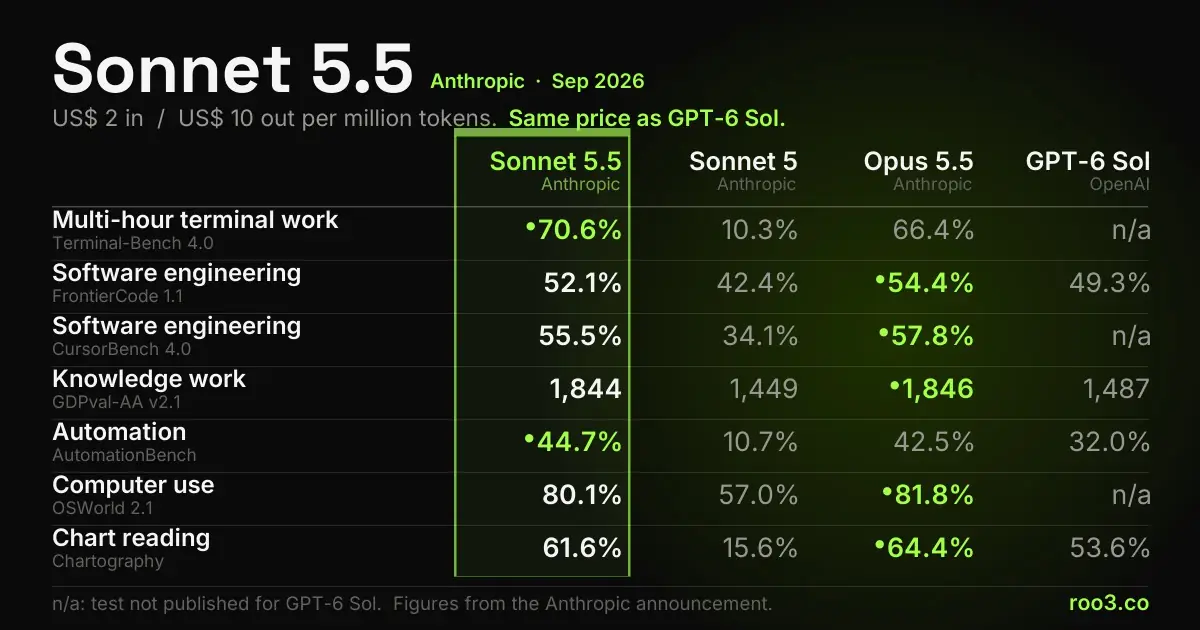
Sonnet 5.5: benchmarks, pricing and the real cost per task
Claude Sonnet 5.5 benchmarks against Opus 5.5, Sonnet 5 and GPT-6 Sol, a price identical to OpenAI's, and the effort...
16 min read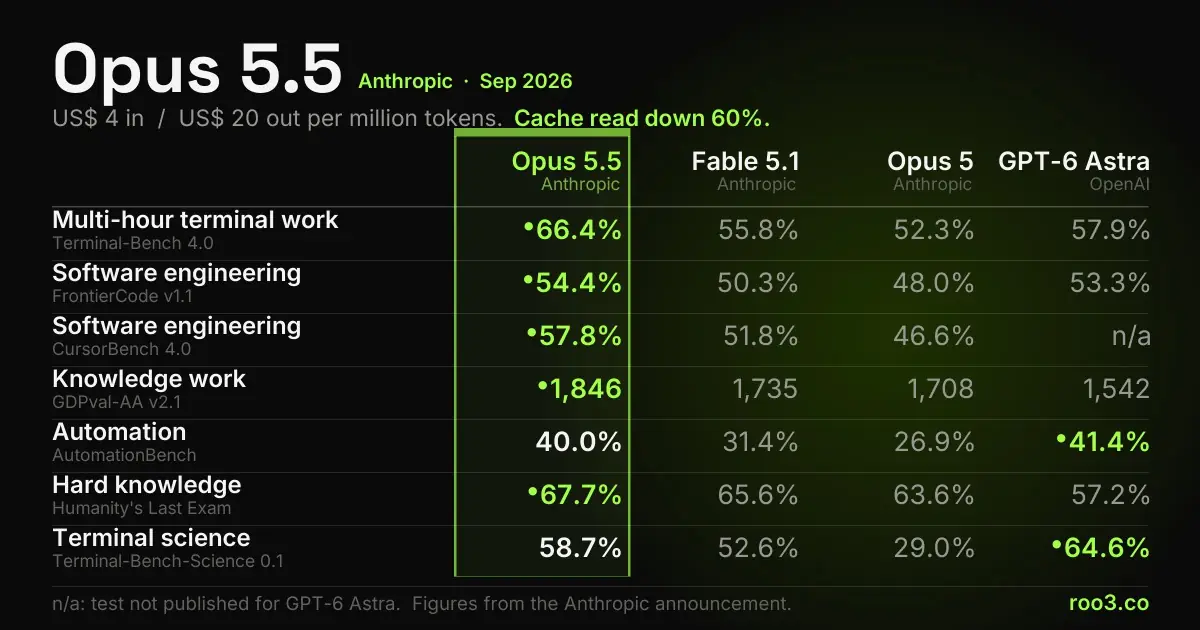
Opus 5.5: the expensive one got better and cheaper at once
Official Claude Opus 5.5 benchmarks against Fable 5.1, Opus 5 and GPT-6 Astra, the price per token, the 60% drop in...
11 min read
Tokens and the context window: why the AI bill comes in high
What a token is, what a context window is and how billing really works. With the arithmetic done and the four mistakes...
11 min readWant to apply this in your company?
ROO3 diagnoses what can be automated first in your business. The first conversation is free.